Built Wrong from the Start: How Flawed Vacuum System Installation Is Quietly Eroding Your Facility's Productivity
There is a particular frustration that facility managers know well: a vacuum system that has never quite performed the way it should. Operators compensate with workarounds. Maintenance teams replace components more frequently than expected. Production supervisors accept throughput limitations as an unavoidable fact of life. In many cases, the culprit is not aging equipment or inadequate capacity—it is the original installation itself.
Across US manufacturing facilities, poorly executed vacuum system installations represent one of the most underdiagnosed sources of operational inefficiency. Because the consequences unfold gradually rather than catastrophically, the connection between installation quality and day-to-day performance losses is rarely made. The result is a facility that spends years—sometimes decades—paying for decisions made during a rushed or poorly supervised commissioning process.
Why Installation Quality Is Frequently Overlooked
Vacuum systems occupy a peculiar position in facility infrastructure. They are essential to production, yet they are often treated as secondary to the primary process equipment they support. When a new production line is commissioned, the vacuum infrastructure is sometimes designed as an afterthought, sized to meet minimum specifications rather than optimized for real-world operating demands.
In other cases, facilities inherit systems from previous ownership or expand operations without revisiting whether the original installation remains appropriate for current demands. The assumption that an existing system is correctly configured—simply because it has been running without obvious failure—is one of the most costly assumptions a facility manager can make.
Common Installation Errors That Penalize Performance
Undersized Distribution Piping
Among the most prevalent and damaging installation errors is the use of distribution piping that is too narrow for the system's actual flow requirements. When pipe diameter is insufficient, pressure drop across the distribution network increases substantially. The vacuum pump must work harder to compensate, consuming more energy while delivering less usable vacuum at the point of application.
This problem is frequently the result of initial cost-cutting—smaller-diameter pipe is cheaper to purchase and install. However, the long-term energy penalty and the reduction in effective system capacity far outweigh any upfront savings. In high-demand applications such as conveying, lifting, or process filtration, undersized piping can reduce effective vacuum levels by 15 to 30 percent compared to a properly engineered network.
Incorrect Valve Placement and Configuration
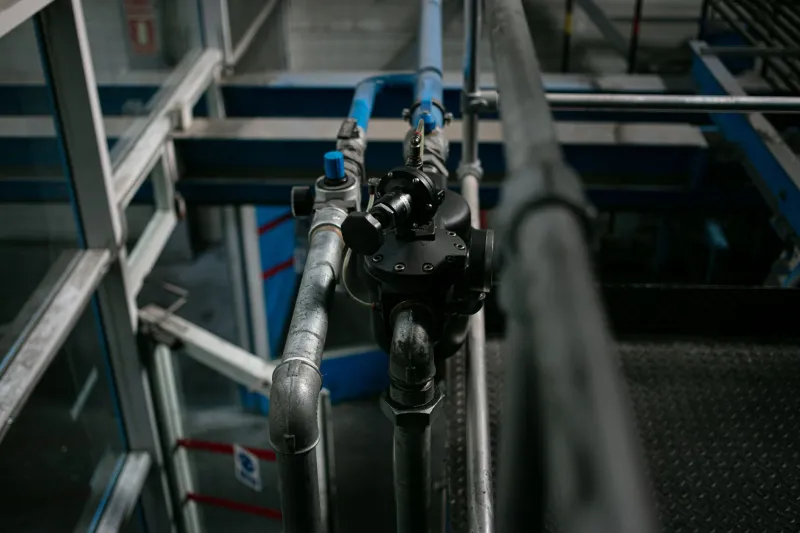
Valves serve critical functions in vacuum distribution systems: they isolate zones, balance flow, and enable maintenance without full system shutdown. When valves are positioned incorrectly—or when the wrong valve type is specified for a given application—the consequences include turbulence-induced pressure losses, uncontrolled air infiltration, and difficulty achieving consistent vacuum levels across the facility.
A particularly common mistake involves the use of gate valves or ball valves in locations where butterfly or vacuum-rated isolation valves are required. These substitutions are often made in the field to reduce costs or because the correct component was unavailable at the time of installation. The performance penalty may be modest in isolation, but across a system with multiple valve errors, the cumulative effect is significant.
Misplaced or Improperly Sized Filtration
Filtration placement is one of the most technically demanding aspects of vacuum system design, and it is also one of the areas most frequently compromised during installation. Filters positioned too close to the vacuum pump restrict airflow and accelerate pump wear. Filters placed too far downstream from the material source allow particulate contamination to migrate through the system, damaging downstream components and reducing overall service life.
Filter sizing errors compound the problem. An undersized filter element increases differential pressure across the filtration stage, reducing the vacuum available at the point of use. An oversized element in a low-velocity application may fail to capture fine particulate effectively, leading to premature pump failure and increased maintenance costs.
Inadequate System Balancing
A vacuum distribution network that serves multiple points of use must be properly balanced to ensure that each application receives adequate vacuum without starving others. When a system is installed without formal balancing—a process that involves adjusting flow restrictors, verifying pipe sizing across branches, and confirming pump capacity relative to total demand—the result is uneven performance across the facility.
Operators in high-demand zones experience insufficient vacuum, while those in low-demand areas may have excess capacity they cannot use. Rather than addressing the underlying imbalance, facilities often respond by running pumps at higher capacity continuously, accelerating wear and increasing energy consumption.
The Retrofit Path: Restoring Performance Without Full Replacement
The good news is that most installation-related performance losses can be recovered through targeted retrofitting rather than complete system replacement. The following checklist provides a structured starting point for facility managers evaluating their existing vacuum infrastructure.
1. Commission a Pressure Drop Survey Measure vacuum levels at the pump outlet, at key distribution points, and at each major point of use. Significant discrepancies between these readings indicate where pressure losses are occurring and help prioritize corrective action.
2. Audit Pipe Sizing Against Current Demand Compare the existing pipe diameters against the actual flow rates required by current production processes. If your facility has expanded since the original installation, there is a strong likelihood that portions of the distribution network are undersized for present-day demand.
3. Inspect and Catalog All Valves Document the type, location, and condition of every valve in the system. Identify any instances where valve specifications do not match application requirements and flag these for replacement or reconfiguration.
4. Evaluate Filtration Placement and Sizing Review the location of all filtration stages relative to material sources and vacuum pumps. Confirm that filter elements are appropriately sized for actual flow velocities and that differential pressure across each filter is within the manufacturer's specified operating range.
5. Perform a System Balancing Assessment With the system operating under normal production conditions, measure vacuum levels across all active use points. Identify branches where vacuum is consistently below target and investigate whether the cause is a distribution issue, a filtration restriction, or a valve configuration problem.
6. Engage a Qualified Systems Engineer While the steps above can be completed internally, the analysis of findings and the development of a corrective action plan benefit significantly from the involvement of a vacuum systems engineer familiar with industrial distribution design. The investment in professional evaluation typically yields a return within the first year through energy savings and reduced maintenance costs alone.
The Cost of Inaction
Facilities that delay addressing installation-related inefficiencies do not simply maintain the status quo—they continue to accumulate costs. Energy consumption remains elevated, maintenance intervals shorten, and production reliability suffers. In competitive manufacturing environments, these are disadvantages that erode margins over time.
More significantly, the longer a poorly installed system operates, the more difficult it becomes to distinguish installation errors from equipment wear. Pumps that have been laboring under excessive load for years may exhibit genuine mechanical degradation, even if the original installation error is corrected. Early intervention preserves the useful life of existing equipment and defers capital replacement expenditures.
Conclusion
A vacuum system that was installed incorrectly does not announce its deficiencies loudly—it simply underperforms, day after day, while the associated costs accumulate invisibly. For facility managers committed to operational efficiency, revisiting installation quality is not a niche concern. It is a fundamental element of responsible asset management.
Mat-Vac Systems works with manufacturing facilities across the United States to evaluate existing vacuum infrastructure, identify installation-related performance gaps, and develop practical retrofit strategies that restore capacity without unnecessary capital expenditure. If your system has never quite performed as expected, the answer may be simpler—and more correctable—than you think.