Mission-Critical Yet Overlooked: Closing the Monitoring Gap in Industrial Vacuum Operations
There is a persistent contradiction embedded in the way many US manufacturing facilities manage their infrastructure. Walk through a modern plant floor and you will likely find vibration sensors on compressors, temperature alerts on drive motors, and automated fault logging on CNC equipment. Then ask the maintenance supervisor when the central vacuum system last received a structured health check — and the answer is often uncomfortably vague.
This is not a marginal oversight. In facilities where vacuum systems convey raw materials, evacuate process chambers, or remove hazardous particulate, an unmonitored system is effectively a ticking liability. Understanding why this monitoring gap exists — and what it costs — is the first step toward closing it.
Why Vacuum Systems Fall Through the Monitoring Net
The neglect is rarely intentional. It tends to emerge from a combination of institutional habit, equipment perception, and competing budget priorities.
First, vacuum systems are designed to be quiet and unobtrusive. Unlike a press or a conveyor, a well-functioning vacuum unit does not demand attention. It hums in a mechanical room, does its job, and stays out of the way. That invisibility is operationally convenient — until it isn't.
Second, many facilities inherited their vacuum infrastructure without formal documentation. Equipment installed during a plant expansion five or ten years ago may lack original specification sheets, baseline performance data, or an assigned maintenance owner. Without a baseline, there is nothing to compare current performance against, which makes monitoring feel abstract.
Third, vacuum systems are frequently categorized as utility assets rather than production assets in CMMS platforms. That classification places them in a lower-priority maintenance tier alongside HVAC units and lighting systems — despite the fact that, operationally, they may be just as production-critical as the machinery they serve.
The Warning Signs That Go Unrecognized
Because facility teams are not actively watching vacuum systems, the early indicators of degradation tend to be misattributed or ignored entirely.
Gradual suction loss is among the most common and most misread signals. When vacuum pressure at the point of use declines incrementally over weeks or months, operators often compensate by adjusting process parameters rather than investigating the system itself. By the time the loss is severe enough to affect production output, the underlying cause — a worn impeller, a failing seal, a developing filter bypass — has typically advanced well beyond its earliest, least expensive intervention point.
Elevated motor temperatures are another frequently overlooked indicator. A vacuum pump motor running warmer than its rated operating range is working harder than it should. That condition may reflect a blocked inlet, a deteriorating bearing, or a system operating outside its designed duty cycle. Without temperature monitoring, that signal goes undetected.
Intermittent pressure fluctuations often get attributed to process variation rather than system instability. In reality, cyclic pressure inconsistency can indicate air leaks in the distribution network, valve degradation, or separator performance issues — all of which compound over time if left unaddressed.
Unusual auditory changes — new harmonics, increased discharge noise, or subtle changes in the pitch of a running motor — are among the earliest physical warnings a system provides. In the absence of a structured inspection cadence, these sounds are background noise rather than diagnostic data.
What Basic Sensor-Based Monitoring Actually Looks Like
The term "predictive monitoring" can conjure images of expensive, enterprise-scale IoT deployments that feel out of reach for mid-sized manufacturers. In practice, meaningful vacuum system monitoring can begin with a relatively modest instrumentation investment.
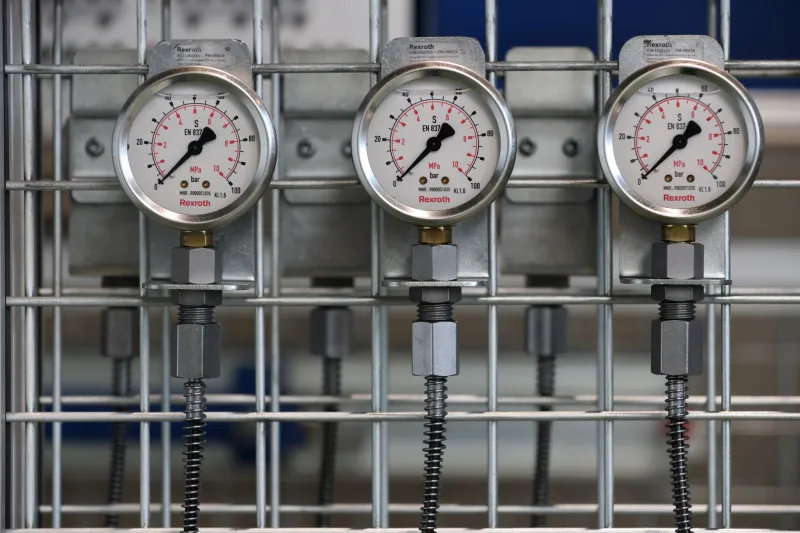
At minimum, a well-monitored vacuum system should include continuous tracking of inlet vacuum level, discharge pressure, motor current draw, and operating temperature. These four data streams, logged against time and compared to established baselines, provide a remarkably complete picture of system health.
Vacuum transducers installed at key points in the distribution network can identify where pressure losses are occurring — whether at the pump, in the piping, or at specific process connections. This localization capability transforms a vague symptom into an actionable work order.
Motor current monitoring is particularly valuable because it serves as a proxy for mechanical load. A pump that is drawing more current than its baseline profile suggests is encountering resistance somewhere in the system. Catching that deviation early allows maintenance teams to investigate before the motor reaches a thermal trip or, worse, a hard failure during a production run.
For facilities with multiple vacuum points or centralized systems serving several production zones, differential pressure monitoring across filters and separators can automate what has historically been a manual inspection task — and do so continuously rather than on a monthly walkthrough schedule.
Shifting the Maintenance Model: From Reactive to Predictive
The financial case for this shift is straightforward, even if it is not always immediately visible in a maintenance budget.
Emergency vacuum system repairs consistently cost more than planned maintenance interventions — not only in parts and labor, but in the downstream costs of unplanned downtime, expedited shipping for replacement components, and the operational disruption of restarting a halted process. In industries where vacuum systems support cleanroom environments, material conveying, or continuous process operations, a single unplanned failure event can represent costs that dwarf an entire year of preventive monitoring investment.
Beyond the direct cost comparison, predictive monitoring enables maintenance scheduling to align with production windows rather than interrupt them. When a system's data trend indicates that a filter will require replacement within two to three weeks, that service can be planned for a scheduled shutdown or a low-production period — not forced upon the facility at the least convenient moment.
There is also a longer-term asset management benefit. Facilities that accumulate historical performance data on their vacuum systems make better capital planning decisions. Rather than replacing equipment on an arbitrary schedule or waiting for catastrophic failure, they can extend the service life of assets that are genuinely performing well while prioritizing replacement of systems whose data profiles indicate accelerating degradation.
Building the Business Case Internally
For facility managers seeking to implement vacuum system monitoring, the internal justification often requires framing the investment in terms that resonate with operations and finance leadership.
A useful starting point is a brief historical audit: how many vacuum-related maintenance events occurred in the past 24 months, what was their average cost, and how many of them were unplanned? That data, even if imprecise, typically reveals a reactive maintenance pattern that sensor-based monitoring could meaningfully interrupt.
From there, a phased implementation — beginning with the highest-criticality systems and expanding as value is demonstrated — tends to be more organizationally sustainable than a facility-wide deployment. It allows the monitoring program to build a track record before it requires significant capital commitment.
The vacuum systems running in your facility right now are almost certainly telling you something. The question is whether your operation has the instrumentation in place to listen.